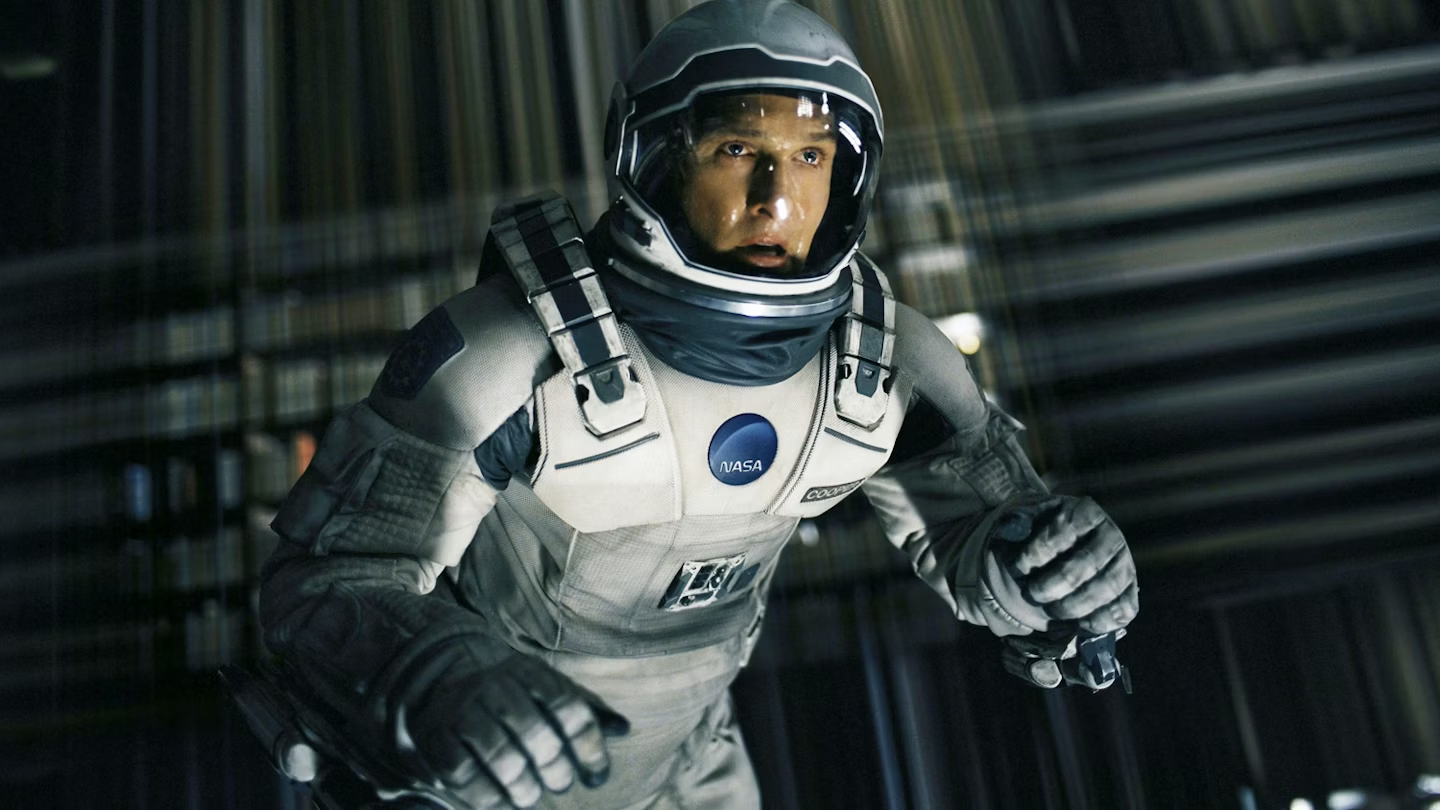
Spielberg turned it down. Warner Bros. almost shelved it. But Robert Zemeckis’s Contact (1997) survived its troubled production to become one of the most emotionally intelligent sci-fi films ever made. If Interstellar left you staring at the ceiling thinking about what’s out there, Contact will do the same thing, and it got there two decades earlier.
Why You’ll Love It
Jodie Foster plays Dr. Ellie Arroway, a SETI astronomer who has spent her career searching for extraterrestrial signals while the scientific establishment dismisses her work. When she finally detects an unmistakable message from the star Vega, the discovery ignites a global firestorm over who gets to make first contact and what it means for humanity.
Where Interstellar uses black holes and time dilation to explore love across dimensions, Contact asks an equally massive question with far less spectacle: if the universe sent us a message, would we even be ready to hear it? The film treats that question with extraordinary seriousness. There are no alien invasions, no laser battles. Just one woman’s conviction that the search itself matters.
The Connection
Both films are built on the same emotional foundation. A parent’s love. A scientist driven by something deeper than data. The tension between faith and empiricism. Interstellar’s Cooper leaves his daughter behind to save humanity. Contact’s Ellie lost her father as a child and has been reaching out to the stars ever since, hoping something will answer.
Both films also share a refusal to give you easy answers. Nolan leaves you debating the physics of love inside a tesseract. Zemeckis leaves you debating whether Ellie’s experience was real or imagined. Neither film tells you what to believe. They trust you to sit with the ambiguity.
Carl Sagan wrote the novel Contact is based on, and his fingerprints are everywhere: the reverence for scientific inquiry, the wonder at cosmic scale, the insistence that asking questions matters more than finding answers.
What Makes Contact Special
Foster’s performance is the engine of the entire film. She carries every scene with a combination of intellectual intensity and emotional vulnerability that makes you believe this woman would sacrifice everything for a signal from the stars. It’s one of the great sci-fi performances, period.
The film also features one of the most effective single shots in 90s cinema. You’ll know it when you see it. Zemeckis pulls off a visual trick that hits harder than any CGI spectacle because it’s rooted entirely in character.
Matthew McConaughey appears here too, years before Interstellar, playing a theologian who challenges Ellie’s worldview. The casting coincidence makes watching these films back to back even more rewarding.
The Bottom Line
If you loved Interstellar for its ambition, its emotional core, and its willingness to wrestle with questions bigger than any single film can answer, Contact is the perfect companion piece. It’s quieter, more grounded, and arguably more moving. A film about the most profound discovery in human history that understands the real story isn’t what we find out there. It’s what the search reveals about us.
Filmatic is reader supported. When you click our streaming links and sign up, we may earn a small commission at no extra cost to you. This helps us keep recommending great films.


0 Comments
Share your thoughts — all comments are moderated before appearing.